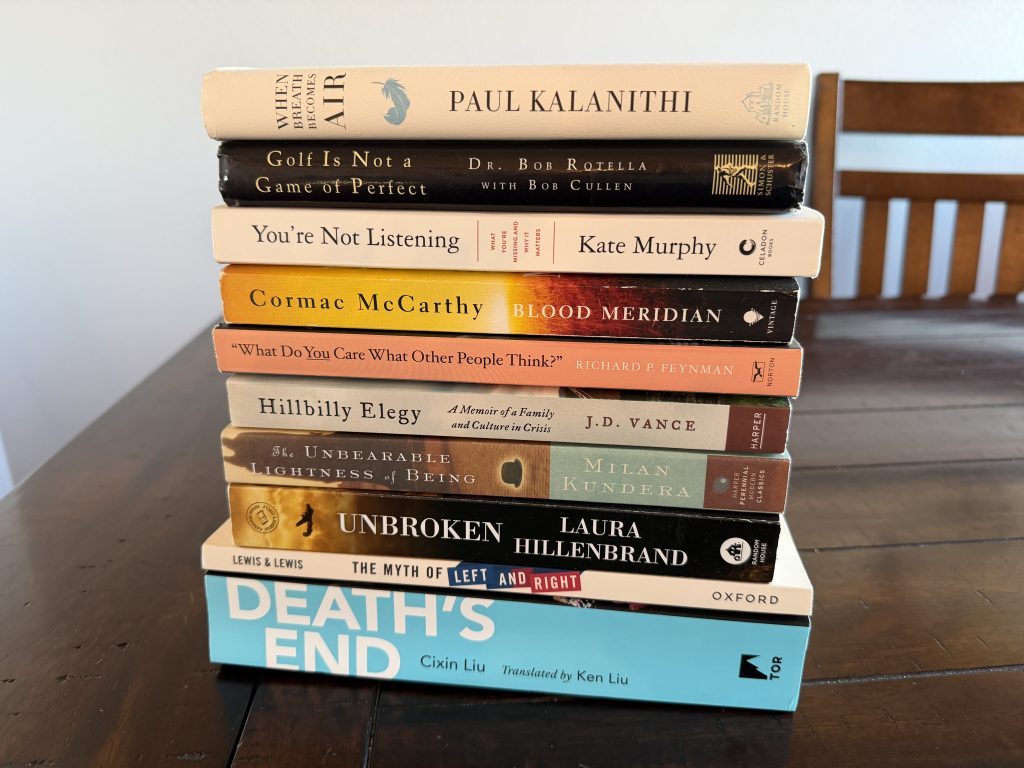
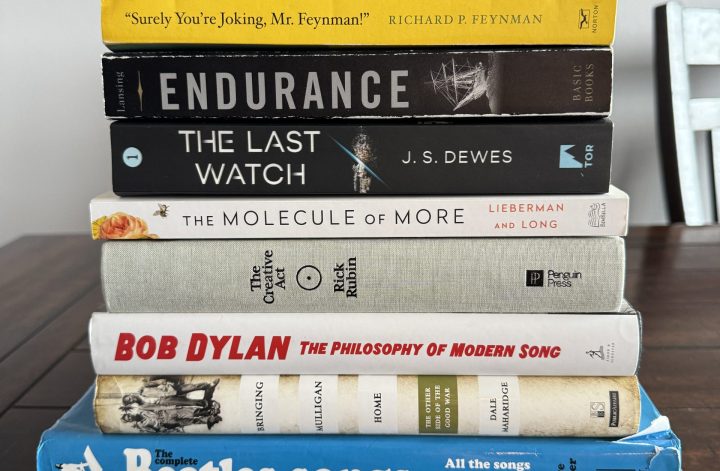
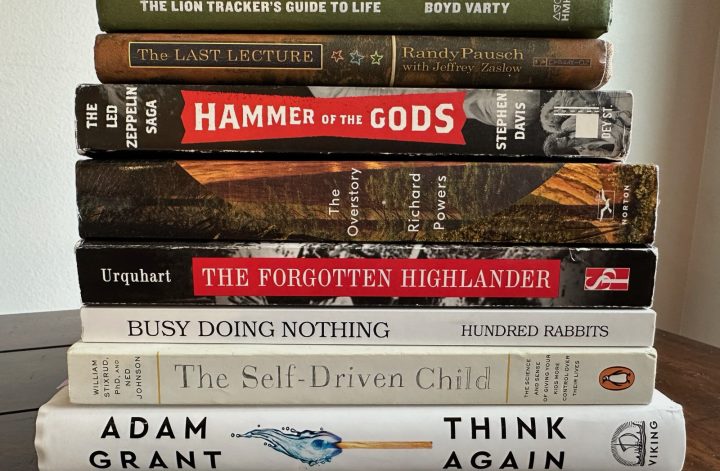
I played 61 rounds of golf this year (up from two in 2024!), significantly cutting into my summer reading time. The result was getting through just 14 books, so my list of favorites is a bit shorter than usual:
Golf is Not a Game of Perfect by Dr. Bob Rotella — Recommended by a golf buddy watching me struggle this summer, it lays out the mental framework needed to play well, along with a lot of helpful tactics and strategies. I plan to review the highlights annually.
Favorite line: People develop pride and find satisfaction, not from doing things that are easy, but from trying things that are difficult, that most people don’t even dare to aspire to.
Unbroken by Laura Hillenbrand — This book details the incredible true survival story of Louis Zamperini during WWII. On track to be the first to break the four-minute mile before the war, he ends up a bombardier in the Pacific. When his plane crashes on a search and rescue mission, he survives 47 days on a small raft before being captured by the Japanese. He then goes on to barely survive two years as a POW.
Death’s End by Liu Cixin — This is the third and final book in the “Remembrance of Earth’s Past” trilogy and by far my favorite sci-fi book since Project Hail Mary. I haven’t watched the Netflix series yet, but now I’m really looking forward to it.
You’re Not Listening by Kate Murphy — The author lays out how we tend to not listen while in conversation, instead focusing on what we are planning to say next. The book could have been 200 pages shorter, but I captured a ton of great highlights and advice.
Favorite lines:
It’s subtle, but profound. And it’s what listening is all about. Everybody has something going on in their heads, whether it’s your child, your romantic partner, your coworker, a client, or whoever. To listen well is to figure out what’s on someone’s mind and demonstrate that you care enough to want to know. That’s what we all crave; to be understood as a person with thoughts, emotions, and intentions that are unique and valuable and deserving of attention.
Integrity and character are not things you are born with; they develop day by day through the choices you make, and that very much includes to whom and how well you choose to listen.
Listening is often regarded as talking’s meek counterpart, but it is actually the more powerful position in communication. You learn when you listen. It’s how you divine truth and detect deception. And though listening requires that you let people have their say, it doesn’t mean you remain forever silent. In fact, how one responds is the measure of a good listener and, arguably, the measure of a good person.
What Do You Care What Other People Think? by Richard P. Feynman — This is an extension of Feynman’s Surely You’re Joking, Mr. Feynman!, adding to his adventures as a world-renowned physicist. Much of this book focuses on his work on the Rogers Commission investigating the Challenger disaster.
Favorite line: But it didn’t hit me hard enough at the time to produce the possibility that I should doubt the truth of stories that don’t fit with nature. When I found out that Santa Claus wasn’t real, I wasn’t upset; rather, I was relieved that there was a much simpler phenomenon to explain how so many children all over the world got presents on the same night! The story had been getting pretty complicated—it was getting out of hand.
The Last of the Wine by Mary Renault — A great example of historical fiction, the book tells the story of a young Athenian boy as he grows up and experiences many of the events that Herodotus details in The Histories. It provides a fascinating look into what life might have been like 2,400 years ago during the Peloponnesian War.
Favorite line: Half the world’s troubles come from men not being trained to resent a fallacy as much as an insult.
The Myth of Left and Right by Hyrum Lewis and Verlan Lewis — The authors lay out the argument that today’s left/right/liberal/conservative ideologies are bundles of unrelated political positions connected by nothing other than a group, and only tribal loyalty holds the positions together. Acknowledging that will go a long way in reducing the division and hostility in today’s politics.
Favorite lines:
Think of it this way: if grocery stores required us to buy one of two baskets of randomly selected products, we would all choose the basket containing more of the products we preferred, but would do so without the illusion that all the products in our basket were better than all the products in the other basket. Unfortunately, when it comes to the “baskets” of politics (parties), we have invented ideological essentialism to delude our ourselves into believing that everything in our political basket (party platform) is superior to everything in the other party’s basket. Just as it would be foolish for someone selecting one of two grocery baskets to make up a story explaining how all the groceries in their chosen basket were bound by an essential characteristic, so it is foolish of us to make up stories about how all the positions of our parties are bound by an essential characteristic.
The problem for American politics, then, is not tribalism per se—after all, tribalism is a fundamental part of human nature and an inevitable part of politics—the problem is that we don’t acknowledge the tribalism. Instead of confronting the reality that we are conforming to tribes, we tell ourselves reassuring stories about how everything our party believes just happens to grow out of a principled ideological essence.
Humility—the willingness to change our minds and falsify our views—is the soul of rationality, but ideology makes us less humble and therefore less rational. While humble thinkers subordinate status to truth and are more concerned about what is right then who is right, ideologues cling to their beliefs, despite contrary evidence, seeing them not as propositions to be tested, but as sacred doctrines to be protected.